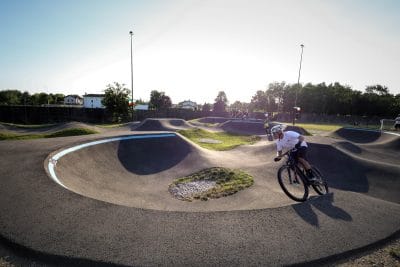
Five steps to chose the right pump track location
Selecting the right spot for a pump track is one of the most important decisions — it determines how often people will use it, how safe it will be, and how well it integrates into the community. Below are five key criteria to guide municipalities and investors in choosing the ideal location.
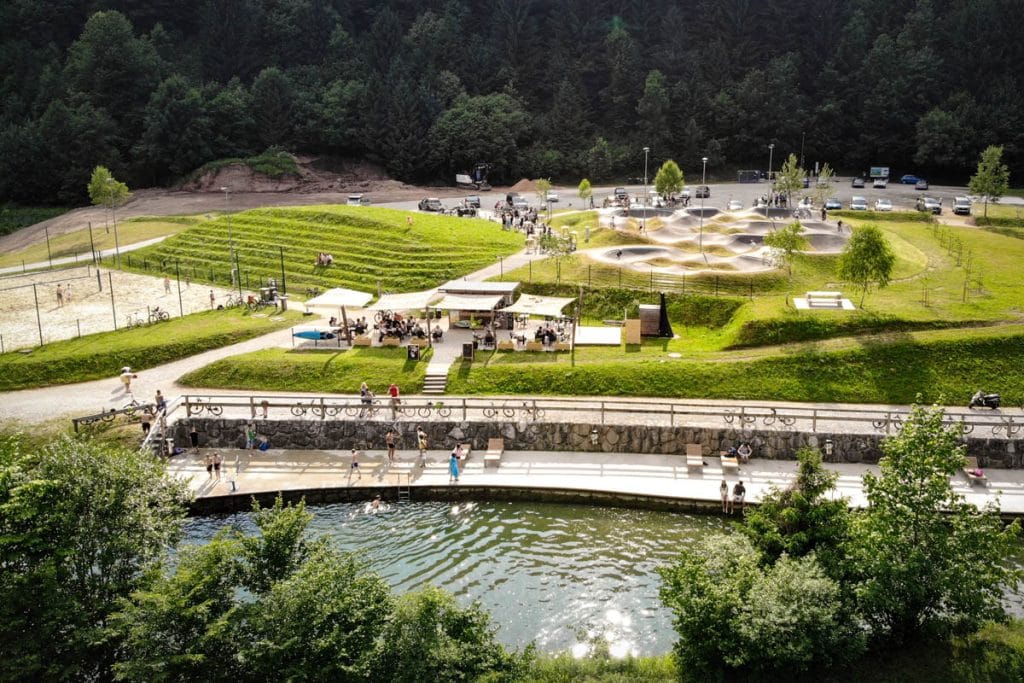
1. Urban Environment — Bring the Pump Track Close to Users
A pump track works best when placed in or near urban areas. That way, it stays close to where people live, play, and gather. Whether near residential neighbourhoods, schools, kindergartens, playgrounds, or sports facilities — such locations help ensure frequent use and community engagement.
By placing the pump track near everyday infrastructure, you make it easy and safe for children, teens, adults — everyone — to access it regularly.
2. Nearby Services — Convenience for Riders, Families & Spectators
When choosing a location, it’s smart to consider proximity to nearby services such as cafés, restaurants, shops, restrooms — or at least make sure there is space for seating, drinking fountains, benches, etc.
This offers comfort for parents or guardians supervising children, and makes the area more inviting for families and other community members. It also makes the track more attractive for events or gatherings.
3. Right Size, Shape & Terrain — Fit the Track to the Plot
- For a small pump track (e.g. for young kids, balance bikes or scooters), a compact plot of about 300 m² can be enough.
- For a broader audience (kids, teens, adults, varied skill levels), a larger area — ideally around 700 m² or more — gives better results.
- Shape matters: a rectangular or square plot is often easiest to work with; narrowest side should not be less than ~17 meters.
- Terrain: ideally a hardened, level or gently sloped surface (e.g. slope up to ~2 %) to reduce need for heavy terrain adjustment.
If the terrain is uneven or slope is steep — adjustments are possible, but that adds to costs.
4. Existing Infrastructure & Buffer Zones — Work with What’s Already There
When selecting a location, take into account existing infrastructure (utilities, roads, public spaces) and any buffer zones required by regulations. Because pump tracks usually require minimal excavation, it’s often possible to build even within buffer zones — if approved by infrastructure managers.
This flexibility can make a formerly underused or degraded area suitable — such as disused parking lots or neglected lots — giving new life to the space.
5. Compliance with Spatial Planning & Protected Area Rules — Respect Regulations
Even though pump tracks are generally simple structures, their construction must respect existing spatial planning documents, zoning laws, and protected-area regulations, if relevant.
Before investing, check that the selected plot is zoned for recreational or public use, and ensure you have any required approvals or permissions.
Why Following These Steps Matters — For Municipalities & Communities
- A pump track placed in the right spot becomes a vibrant, well-used community asset, not an underused facility.
- Proper location helps ensure safety, accessibility, and convenience — key for families, youths, and regular visitors.
- Considered planning reduces long-term costs (terrain work, permits, maintenance) and avoids delays or regulatory issues.
- Thoughtful placement — with services nearby and good infrastructure — boosts the track’s value as a social & recreational hub, potentially increasing community engagement and even local tourism.
Let Us Help You Find the Perfect Spot
If you have a few candidate plots — or even just ideas — we at Alliance ASE can help: we’ll review your options, check feasibility (size, shape, terrain, infrastructure, regulations) and create a free preliminary placement proposal. That way, you get a clear overview of what works best before investing.